
HIPS
at
Blinken OSA
2023 internship
In 2023, the theme of the program was The City and the Archive. Historical Interventions in the Public Sphere, and it took place between January 9 and February 7. Through a series of lectures, site visits, and seminars, the students acquired a critical toolkit that allowed them to deal with memory politics and historical (re)interpretations in the public sphere, from the urban landscape to archival corpora. The city of Budapest provided the opportunity for a concrete exploration of political strategies of deception belonging to the dictatorial regimes of the 20th century up to the populist autocracy of the current times. The Archives served as a “source” documenting sensitive topical issues; in a broader, heuristic sense, it was the laboratory where analogous issues related to the relationship between documents/traces, representations, and historical phenomena were analyzed.
Students were divided into six groups that correspond to six urban sites preselected for them as the most representative, symbolically loaded locations within the historical-political landscape of Budapest. They worked together to produce three videos, two podcasts and one fanzine by doing archival research and conducting interviews.
The internship was conceptualized and led by a team of academics and archivists at Blinken OSA: Ioana Macrea-Toma, István Rév, Zsuzsanna Zádori and Darius Krolikowski, with Balázs Trencsényi (History Department, CEU). It was coordinated by Fanni Andristyák and accomplished with the contribution of colleagues of academic and archival expertise at Blinken OSA: Judit Hegedüs, Katalin Székely, András Mink, Oksana Sarkisova, Anastasia Felcher, Csaba Szilágyi, Balázs Leposa and Miklós Zsámboki. Historians Pieter Lagrou, Stefano Bottoni, Gábor Egry, József Mélyi, Orsolya Sudár and Gréta Süveges were invited to give lectures and city tours about memory politics on a European level and within Hungary. Sessions with public intellectuals, András Török (fortepan.hu), documentarist Barna Szász (Jewish district Budapest) and external archivists, Zsuzsanna Toronyi (Hungarian Jewish Museum and Archive), provided a broader socialization with the professionals in the field of public history.


Project 01
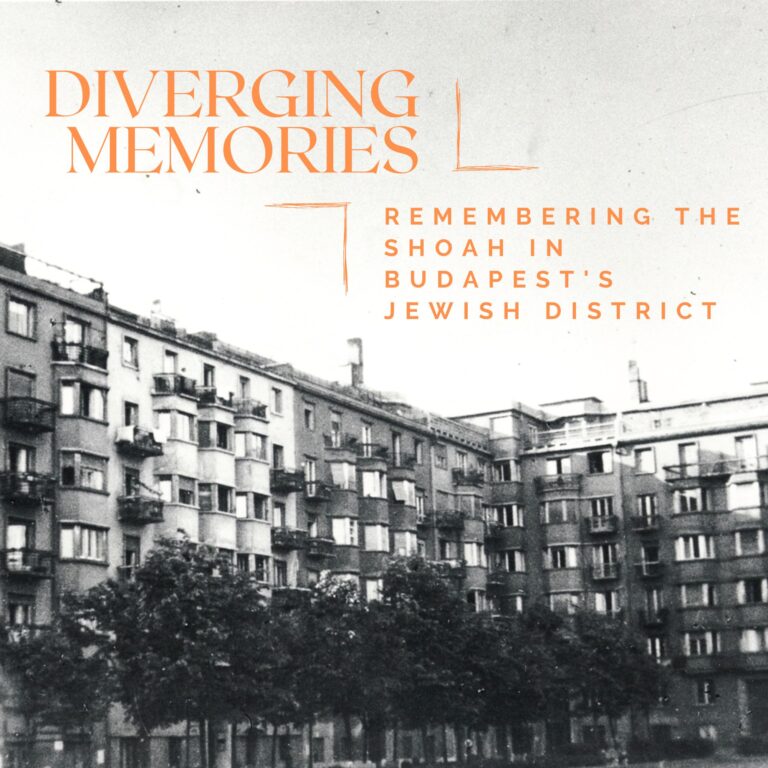
Diverging Memories: Remembering the Shoah in Budapest’s Jewish District
podcast series
Produced by Nina Andro, Kana Fukumoto, Madoka Sakabe, Dasja Zonneveldt
Interviewees: Vera Szekeres Varsa, Gréta Süveges
When you walk around the Jewish district in Budapest today, it seems almost impossible to imagine the horrible events that took place here just 80 years ago. But if you look closely, you can see traces of the past everywhere. Memories of the Second World War can be found in monuments, memorials, and in museums. However, not everyone remembers this past the same way. The podcast series Diverging Memories dives into the history and the memory of the Holocaust in Hungary’s capital city, Budapest. Together with a team of researchers, experts, and eyewitnesses, the host tries to find out what happened during the war and how it is remembered today.
Project website: https://dasjaapps.wixsite.com/divergingmemories
Project 02
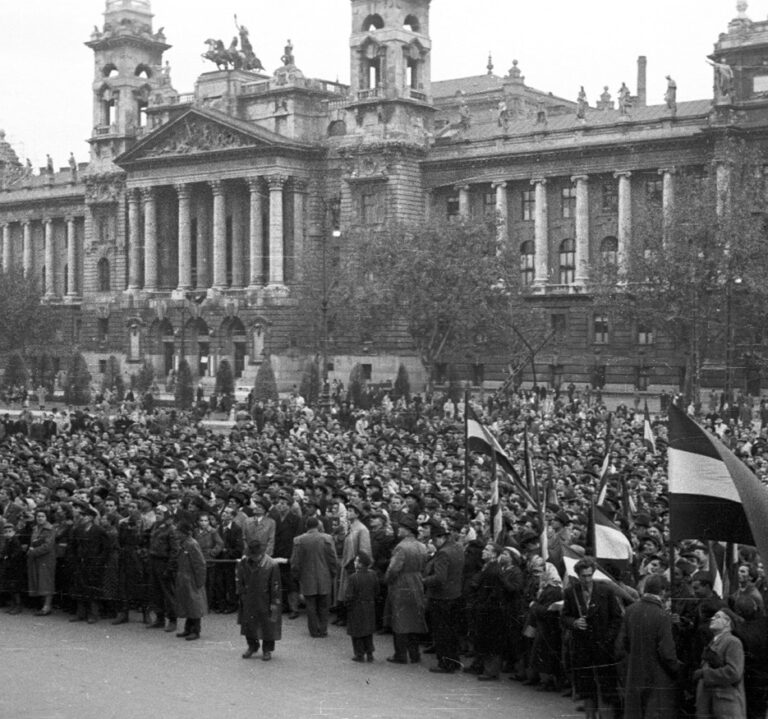
Kossuth Lajos Tér: Past and Present Contested Meanings
podcast
Produced by Asha Trivedy, Unyime Mfon, Tsewang Chozom, Yu Fujioka
Interviewees: Tamás Wachsler, András Török
Kossuth Lajos tér. Often referred to as the center of Hungarian political life, this square has been the site of coups, political contestations, violence, falling statues, reorganizations, protests and tourism.
The history of the square has run in tandem with the history of the Hungarian Parliament building, which is located in front of the square. The flag displayed on the Parliament changed several times, with red flags and EU flags. And today, you can see both the flag of Hungary and the Székelys.
Our podcast asks the questions:
What do the flags displayed on the Parliament building mean?
What do the public think about the square?
To what extent is the meaning of the square important in Hungary?
To answer these questions, we interviewed to Mr. Tamás Wachsler, former member of the Hungarian parliament and designer of renovating the square, as well as Andras Török, historian and one of the founders of Fortepan. Along with archival and social media research, as well as making use of archival music and sound bites, we investigate these questions of one of the most contested sites of public history in Budapest.
Project 03
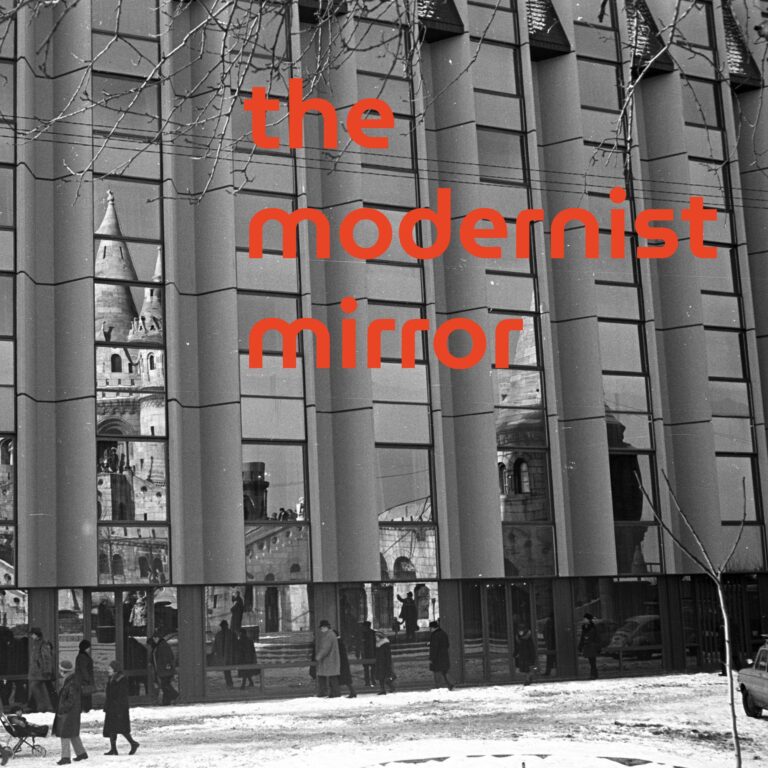
The Modernist Mirror
zine
Produced by Maria Carolina Nassif de Moraes, Evva Parsons, Yitong Xu
Interviewees: András Ferkai, Anna Sándor, Lavinia Sándor
This zine seeks to understand the landscape of the Buda Castle District, with its gaps and reconstructions, within the current political aesthetic moment of 2023. To do so, it includes archived pasts of the district, renovation plans, and interviews from residents and experts. The work accesses the Castle District and its history through the Hilton Hotel, a Modernist building constructed in the 1970s on the partial ruins of a Jesuit College, that had been built upon the remnants of a medieval Dominican monastery. It uses the metaphor of a mirror to examine both the values and ideologies reflected in the built environment of the Castle District and those concealed behind the mirror of the material space of the neighborhood. This zine is our way to share our findings with you, moving non-chronologically in the histories of the Castle District to explore its inheritances and disjunctures.
Project website: https://issuu.com/mcarolinanassif/docs/themodernistmirror
Project 04
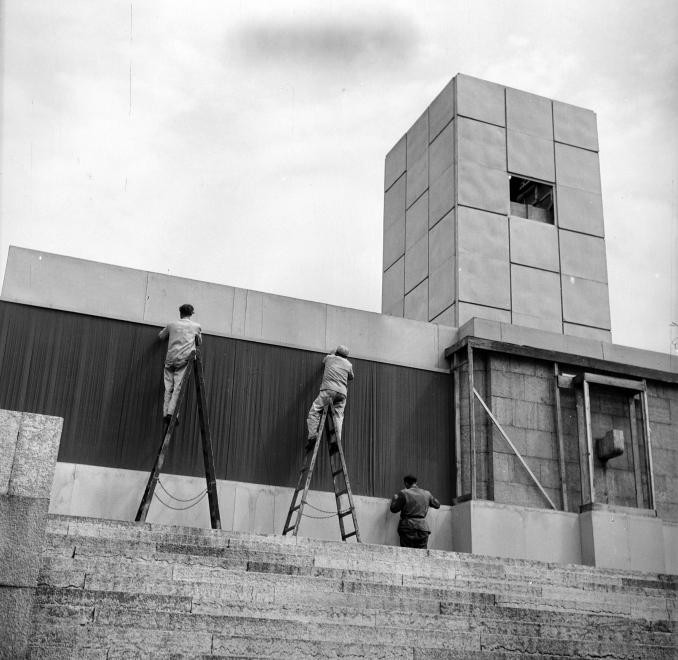
Stage(S). The Tribune on Dózsa György út. 1949-1991
video
Produced by Mako Hasegawa, Edoardo Bastianini, Chisa Nagaoka
On March 15, 1991, a rock concert took place in downtown Budapest on a ruined tribune symbolic of a not-too-distant past. The tribune, built in 1949, became the stage for the Communist regime and its propaganda. However, through the destruction of part of the City Park for the construction of the grandiose Parade Square, the stage transformed and changed the City Park's space and its use. The March 15 and May 1 parades were the ideal time to show the strength of the Communist government and loyalty to the Soviet bloc. By the way, the ambivalence between political actors and the civil population gave an overlap of meanings to the role of the tribune itself in the history of the country.
In today's Dózsa György út domestic and foreign policy, army and civilian population, regime propaganda and opposition confront each other in the same place. The tribune represented, in this sense, a place carrying multiple and multi-faceted memories and symbols. In a cycle of destruction and reconstruction, it traverses Hungary's postwar history, on the border between Communism, the Cold War, democratization, and generational clash. This evolution is powerfully visible in the plurality of names that run through the history of the area, some official and others the result of popular protest, including the key transition during the Hungarian Revolution of 1956 from Stalin Square to Boots Square.
Through in-depth bibliographic research, using unpublished archival sources, interviews, articles, and testimonies, the authors offer a fresh picture of Dózsa György út in Budapest and its past in the second half of the 20th century. With a look at the present time, it opens a critical reflection on the multi-layered overlapping of memory sites and the difficulties of making history in the public sphere, while considering the complexity of urban transformations.
Project 05
A Hungarian Rhapsody
video
Produced by Mariame Maouhoub, Julianna Vas, Carina Schröter
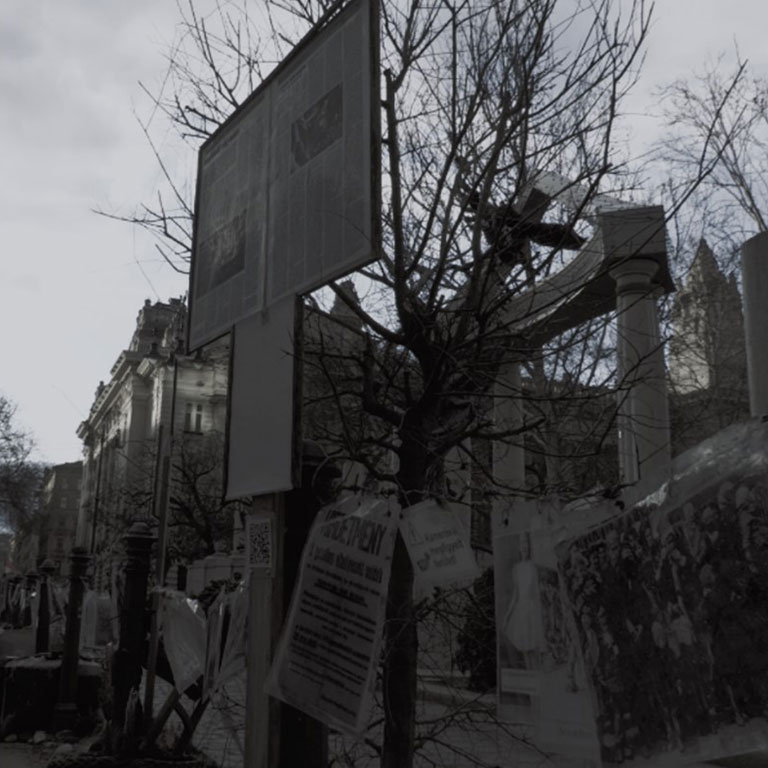
In 2013, the Hungarian government unveiled plans to build the Monument to the Victims of the German Occupation. The monument quickly became the center of public criticism. Despite the criticism, the government persisted with their plans. To show their dissent, activists and civilians erected a memorial directly facing it. Both monuments are dedicated to the victims of the German Occupation of Hungary. But why do the government and the public disagree on these monuments?
This documentary revisits the sombre debate around the opposing monuments and the history they present to the public in the heart of Budapest. It showcases how history is actively shaped by different stakeholders and how monuments can falsify historical narratives. The contributing interviewees shed light on the different aspects the monuments represent for the public and the issues that arise.
Project 06
Grey Zone – A Documentary about Corvin Köz and II. János Pál Pápa Tér (Formerly Köztársaság Tér)
video
Produced by Alison Dringenberg, Kitty Sillars, Lea Pflueger
Interviewees: Stefano Bottoni, Gábor Egry
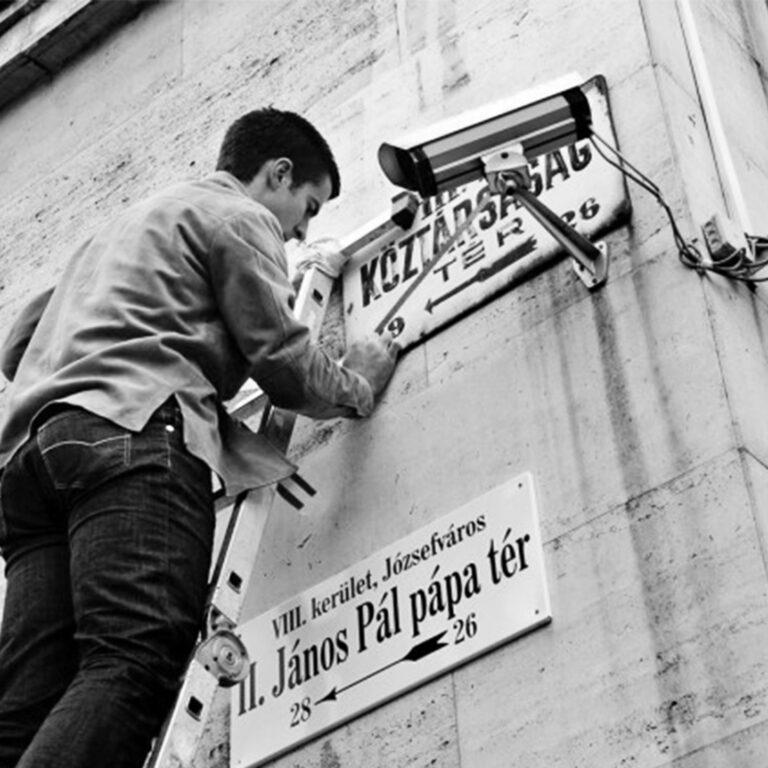
This documentary investigates the nature of memory and non-memory in Corvin Köz and II. János Pál Pápa tér, two key sites of the Hungarian Revolution of 1956. The primary focus is how the events of 1956 are commemorated, remembered, or forgotten in these urban spaces. While Corvin Köz is adorned with plaques, monuments, and flags, along with the indomitable figure of the "Pest Lad", the Hungarian Socialist Workers’ Party Headquarters has been left to ruin in the former Köztársaság tér, with no sign of its violent past. Through expert interviews as well as archival and contemporary footage, we shed light on the polarizing dynamics of Hungarian memory politics.